Principles of budget-friendly balanced eating
Eating a balanced diet on a budget starts with the same building blocks that define a healthy dietary pattern: vegetables and fruits, whole grains, protein foods, dairy or fortified soy alternatives, and healthy oils. The Dietary Guidelines for Americans, 2020-2025 describes the Healthy U.S.-Style Dietary Pattern in these terms, with at least half of grains coming from whole grains and limits on added sugars, saturated fat and sodium. Budget-friendly eating applies that same framework while paying attention to price, availability and waste.
The Dietary Guidelines also recognizes that food choices are shaped by many factors, including age, cultural traditions, environment, food access, budget, and personal beliefs and preferences. That means there is no single correct way to eat well on a limited budget; the goal is to build a pattern you can sustain with the foods available to you.
A useful principle is to focus on dietary patterns rather than single nutrients or superfoods. The Dietary Guidelines emphasizes variety across food categories, so health benefits come from the overall mix of foods rather than from a few expensive specialty items. This approach naturally supports budget eating because it rewards ordinary, widely available foods.
- Fill about half your plate with vegetables and fruits (excluding potatoes, which are not counted as vegetables in the Healthy Eating Plate), a quarter with whole grains, and a quarter with protein foods.
- Choose water, coffee or tea as your main drinks and limit sugary beverages.
- Aim for variety across food groups rather than relying on a few costly items.
- Plan ahead, consider seasonal and regional availability, and use a mix of fresh, frozen, dried and canned options.
Sources: U.S. Department of Agriculture and U.S. Department of Health and Human Services, The Nutrition Source, Harvard T.H. Chan School of Public Health
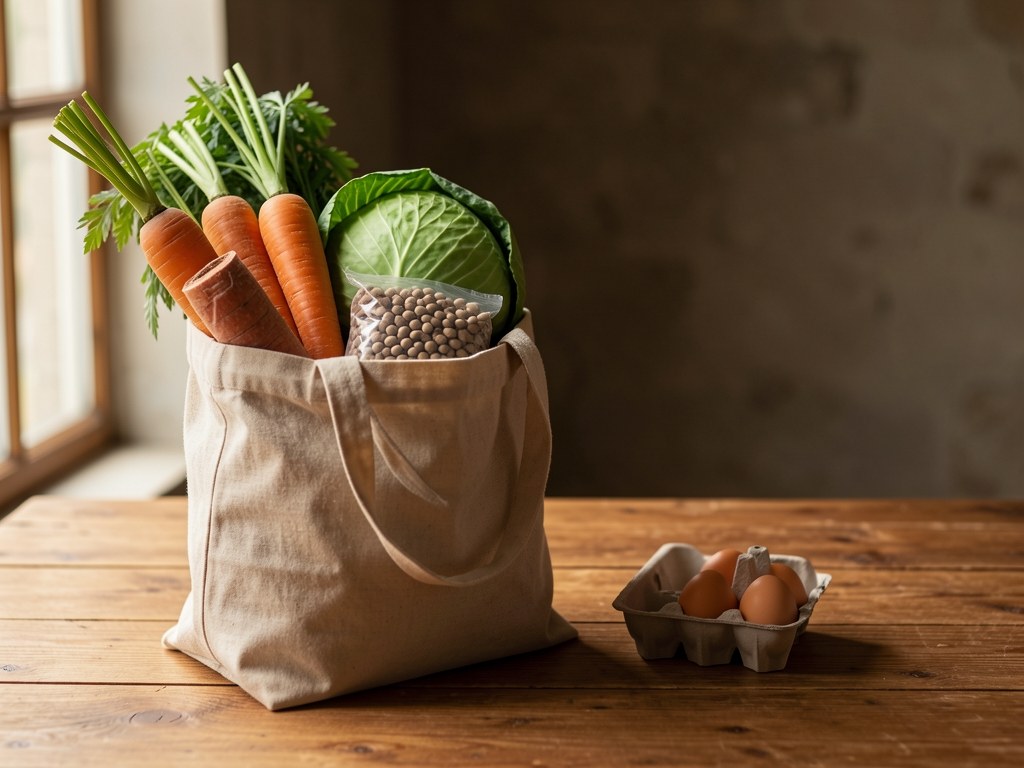
Smart shopping: store brands, sales, and bulk buys
Shopping with a plan is one of the most reliable ways to control grocery spending. Harvard's The Nutrition Source advises planning a few meals for the coming week and building a shopping list from those ingredients before going to the store. Leaving some flexibility in that list lets you take advantage of sale-priced fresh produce, poultry or fish, which you can buy in extra quantities and freeze for later.
Store-brand and generic products generally cost less because less money is spent on advertising and elaborate labels, and their ingredient lists are often similar or identical to name-brand versions. Comparing price per unit is another simple habit: a larger bag of a staple often costs less per pound or per ounce than a smaller one, even when the upfront price is higher. Harvard gives the example of a 5-pound bag of rice at about $0.80 per pound being cheaper than a 1-pound bag at $1.59 per pound, though actual prices vary by market and over time.
Buying nonperishable staples in bulk is a related strategy. Whole grains, lentils and dried beans are examples where the larger package usually costs less per unit even when the upfront cost is higher. Checking the discounted produce cart can also help, since it often holds produce that is beginning to age but is still usable if eaten the same day or the next day. It is also worth taking inventory of what you already have in the kitchen twice a month and planning meals around those items before buying more.
- Plan meals for the coming week and write a list before shopping.
- Leave room on the list for sale-priced produce, meat or fish that can be frozen.
- Compare price per unit rather than package price alone.
- Choose store brands when the ingredient list is comparable.
- Buy shelf-stable staples such as whole grains, lentils and dried beans in bulk to lower cost per unit.
- Check the discounted produce cart and use those items promptly.
- Take stock of your kitchen twice a month before buying more food.
Sources: The Nutrition Source, Harvard T.H. Chan School of Public Health
Affordable nutrient-dense staples
Certain foods deliver a lot of nutrition for relatively little money. Harvard's inexpensive staples list highlights beans, peas and lentils in dried, frozen or canned form; canned fish such as tuna, salmon and sardines; 90% lean ground turkey; chicken thighs with skin; peanut butter; low-fat cottage cheese; tofu; and eggs as economical protein choices available year-round.
For produce, the same list points to leafy greens such as kale and collards, whole heads of lettuce or cabbage, broccoli, radishes, fresh carrots, apples and bananas, sale-priced fresh produce, frozen unsweetened fruit, and frozen or canned vegetables without added salt. Whole grains include store-brand high-fiber cereals such as plain shredded wheat and bran, whole rolled oats, dried whole grains such as brown rice, millet, barley and bulgur, and whole grain pasta. Peanuts, dried popcorn kernels for an air-popper and string cheese are listed as economical snacks.
When choosing canned or frozen foods, Harvard advises selecting options without extra sodium, sugar or other additives. Low-sodium seasonings such as cumin, curry, thyme, paprika, onion powder, garlic powder, reduced-sodium tomato paste, vinegars and liquid vegetable oils can add flavor without much cost.
- Proteins: dried, frozen or canned beans and lentils; canned tuna, salmon or sardines; eggs; tofu; peanut butter; low-fat cottage cheese.
- Produce: kale, collards, cabbage, broccoli, carrots, apples, bananas, frozen unsweetened fruit, no-salt-added canned or frozen vegetables.
- Whole grains: rolled oats, brown rice, barley, bulgur, whole grain pasta, plain shredded wheat or bran cereal.
- Snacks: peanuts, air-popped popcorn, string cheese.
- Seasonings: cumin, curry, thyme, paprika, onion powder, garlic powder, vinegars, vegetable oils.
Sources: The Nutrition Source, Harvard T.H. Chan School of Public Health
Meal planning to reduce waste and cost
Meal planning reduces both impulse purchases and spoilage, and it directly lowers weekly grocery costs. The core habit is simple: decide on a few meals for the week, check what you already have, and build a list around the gaps. Harvard recommends planning meals and creating a shopping list as the first supermarket savings strategy, and taking inventory of all food in the kitchen twice a month so meals can be built from what is already on hand.
Not buying more highly perishable items than you can use in one week is another way to avoid waste and avoid paying for food that ends up in the trash. Harvard identifies ready-to-eat bagged salad greens, mushrooms, berries, avocados and bananas as highly perishable, and suggests buying them in quantities you can realistically finish unless you plan to freeze them.
Shopping with a plan and not on an empty stomach is also advised; eating a piece of fruit or some nuts before entering the store can make it easier to stick to the list. According to Harvard's The Nutrition Source, mindful eating may increase satisfaction with smaller portions, which can help you get more value from the food you buy.
- Plan a few meals for the coming week and build a list from those ingredients.
- Take inventory of the kitchen twice a month before shopping.
- Buy only as much highly perishable produce as you can use in a week.
- Shop with a plan and not on an empty stomach.
- Eat attentively to get more satisfaction from the food you have.
Sources: The Nutrition Source, Harvard T.H. Chan School of Public Health
Cooking in batches and freezing for savings
Batch cooking and freezing let you take advantage of lower unit prices and sale prices without wasting food. Harvard recommends allowing flexibility in the shopping list so that sale-priced fresh produce, poultry or fish can be bought in extra quantities and frozen for later use. Fresh meats, fish, bananas, berries, avocados, broccoli, cauliflower, Brussels sprouts and corn freeze well according to the same source.
Buying nonperishable staples in bulk can also lower the cost per unit. Whole grains, lentils and dried beans are examples where the larger package usually costs less per unit even when the upfront cost is higher. Fresh herbs can be stretched by chopping and freezing them in an ice cube tray filled with olive oil, and ginger can be stored in an airtight bag and grated from frozen as needed. Scallions or green onions can be regrown by placing the white root ends in a glass of water on a sunny windowsill and changing the water about once per week.
- Buy sale-priced meat, poultry or fish in extra quantity and freeze portions.
- Freeze bananas, berries, avocado, broccoli, cauliflower, Brussels sprouts and corn.
- Buy whole grains, lentils and dried beans in bulk to lower cost per unit.
- Freeze chopped fresh herbs in olive oil in an ice cube tray.
- Store ginger in an airtight bag and grate it from frozen.
- Regrow scallions by placing root ends in water on a sunny windowsill.
Sources: The Nutrition Source, Harvard T.H. Chan School of Public Health
Sample budget-friendly balanced meal ideas
The following meal ideas are examples of how inexpensive staples can be combined into balanced plates. They are meal ideas, not a fixed menu, and they can be adjusted to what is available and affordable where you shop. Each idea follows the general proportions of the Healthy Eating Plate: about half vegetables and fruits, about a quarter whole grains, and about a quarter protein foods, with water as the main drink.
These ideas draw on foods listed as economical choices by Harvard and on the dietary pattern described in the Dietary Guidelines for Americans, 2020-2025, which includes vegetables, fruits, whole grains, dairy or fortified soy alternatives, protein foods and oils. Exact ingredient quantities and serving sizes are not prescribed here because individual needs vary.
- Breakfast: rolled oats cooked with water or milk, topped with frozen unsweetened berries and a spoonful of peanut butter.
- Lunch: bean and vegetable soup made with canned no-salt-added beans, frozen mixed vegetables and reduced-sodium tomato paste, served with whole grain bread.
- Dinner: baked chicken thighs with roasted cabbage and carrots, alongside brown rice cooked from a bulk bag.
- Dinner: tofu and broccoli stir-fry with garlic, ginger and a little vegetable oil, served over whole grain pasta or rice.
- Snack: air-popped popcorn, peanuts or string cheese with an apple or banana.
Sources: U.S. Department of Agriculture and U.S. Department of Health and Human Services, The Nutrition Source, Harvard T.H. Chan School of Public Health
Comparing costs: fresh, frozen, and canned produce
Fresh, frozen and canned produce can all be part of a balanced diet, and the best choice often depends on price, season and how quickly you will use the food. The Dietary Guidelines for Americans, 2020-2025 includes fresh, frozen and canned dark-green leafy vegetables and broccoli among nutrient-dense vegetable options, so form is not the deciding factor for nutrition. Harvard advises choosing canned or frozen options without extra sodium, sugar or other additives.
Cost differences follow availability and season more than a fixed rule. Sale-priced fresh produce and the discounted produce cart can be the least expensive options in season, while frozen unsweetened fruit and no-salt-added canned vegetables offer year-round availability and less spoilage risk. Buying fresh produce that you will not finish before it spoils usually costs more per usable serving than buying a frozen or canned equivalent you can store.
A practical approach is to compare price per unit and consider how much of the package you will actually eat. If fresh produce is on sale and you can use or freeze it, it is often a good buy; if not, frozen or canned forms may stretch further. The Dietary Guidelines notes that using a variety of fresh, frozen, dried and canned options is one strategy that can help individuals and families follow a healthy dietary pattern within budget constraints.
| Form | Typical cost pattern | Shelf life | What to check |
|---|---|---|---|
| Fresh | Varies; often lowest in season or on the discounted produce cart | Short for many items | Buy only what you can use in about a week, or plan to freeze |
| Frozen | Often stable year-round | Long | Choose unsweetened fruit and vegetables without added salt or sauce |
| Canned | Often stable year-round | Long | Choose no-salt-added or reduced-sodium options and rinse if needed |
Sources: U.S. Department of Agriculture and U.S. Department of Health and Human Services, The Nutrition Source, Harvard T.H. Chan School of Public Health
Frequently asked questions
Is frozen produce as healthy as fresh?
Frozen produce can be part of a healthy dietary pattern. The Dietary Guidelines for Americans, 2020-2025 includes fresh, frozen and canned dark-green leafy vegetables and broccoli among nutrient-dense vegetable options, so form is not the deciding factor. When choosing frozen options, Harvard's The Nutrition Source advises selecting those without extra sodium, sugar or other additives, such as frozen unsweetened fruit and plain frozen vegetables.
Sources: U.S. Department of Agriculture and U.S. Department of Health and Human Services, The Nutrition Source, Harvard T.H. Chan School of Public HealthHow can I save on protein sources?
Plant proteins are generally more affordable than meat and fish. Harvard's The Nutrition Source suggests considering meatless meals and, when meat is desired, using smaller amounts as a base for flavor or as a condiment while focusing on beans or tofu to save money and add heartiness. Economical protein foods listed by the same source include dried, frozen or canned beans and lentils; canned tuna, salmon and sardines; eggs; tofu; peanut butter; low-fat cottage cheese; 90% lean ground turkey; and chicken thighs with skin.
Sources: The Nutrition Source, Harvard T.H. Chan School of Public HealthWhat are cheap healthy substitutes for expensive superfoods?
The Dietary Guidelines for Americans, 2020-2025 emphasizes dietary patterns rather than single nutrients or superfoods, so health benefits come from a wide variety of nutrient-dense foods across categories. Ordinary staples can fill the same roles as costlier specialty items: beans, peas and lentils for protein; rolled oats, brown rice, barley, bulgur and whole grain pasta for whole grains; kale, collards, cabbage, broccoli and carrots for vegetables; and apples, bananas and frozen unsweetened berries for fruit. These appear among the economical choices listed by Harvard's The Nutrition Source.
Sources: The Nutrition Source, Harvard T.H. Chan School of Public HealthSources
- Dietary Guidelines for Americans, 2020-2025 — U.S. Department of Agriculture and U.S. Department of Health and Human Services
- Strategies for Eating Well on a Budget — The Nutrition Source, Harvard T.H. Chan School of Public Health
- Healthy Eating Plate — The Nutrition Source, Harvard T.H. Chan School of Public Health
- Dietary Guidelines for Americans 2020 released — The Nutrition Source, Harvard T.H. Chan School of Public Health