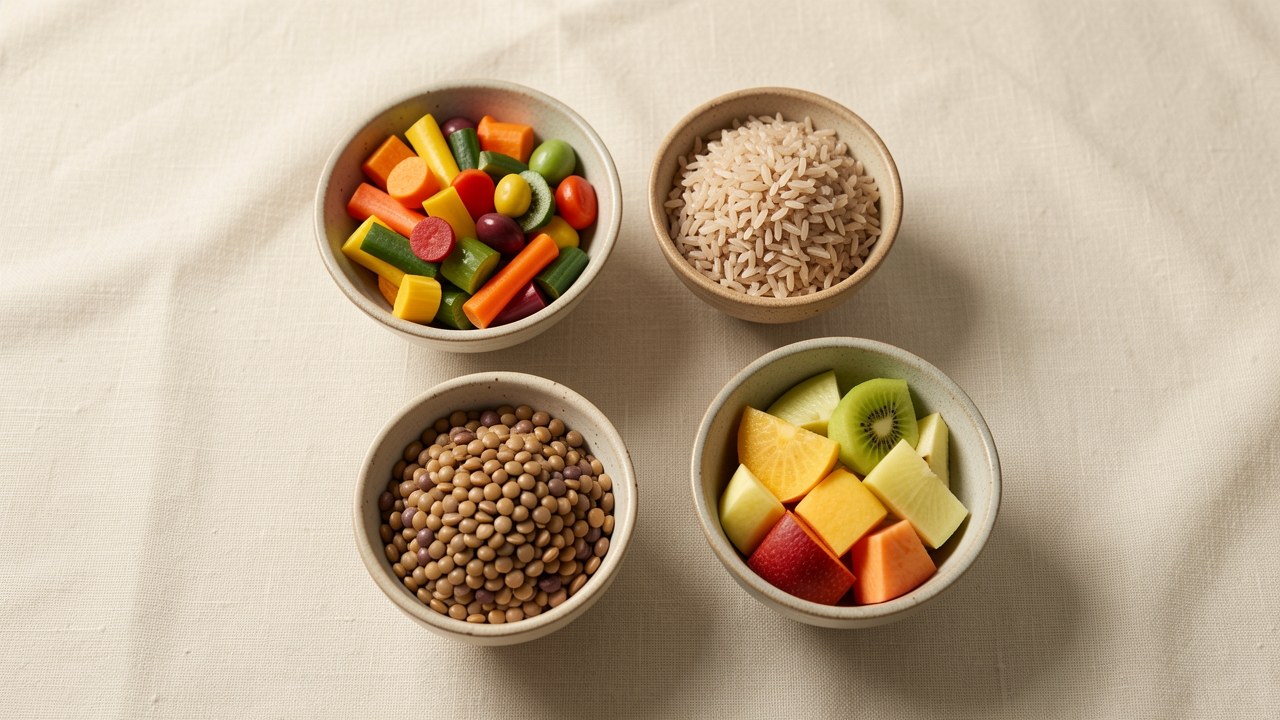
Introduction to the Plate Method
The plate method is a simple way to build balanced meals without counting every calorie or gram. Instead of measuring servings exactly, you look at the proportions of different foods on your plate. This visual approach makes healthy eating more approachable for everyday life.
Both the USDA MyPlate and Harvard's Healthy Eating Plate use this visual framework. They recommend filling half your plate with vegetables and fruits, and splitting the other half between grains and protein foods. These models are supported by the Dietary Guidelines for Americans, which provide more specific serving recommendations.
The plate method works because it shifts the focus to nutrient-dense foods, and it's easily adaptable to your preferences, culture, and schedule. In this guide, you'll learn exactly how to apply these proportions, how to estimate portions without tools, and how to adjust the plate for your energy needs.
Vegetables and Fruits: The Half-Plate Foundation
Both the USDA MyPlate and Harvard's Healthy Eating Plate agree: vegetables and fruits should cover half of your plate. This high proportion helps you meet your daily needs for fiber, vitamins, minerals, and protective plant compounds. Fill this half with a variety of colors and types—leafy greens, cruciferous vegetables like broccoli, colorful peppers, berries, apples, and citrus fruits.
The USDA's Food Patterns translate this into specific daily goals: for a 2,000-calorie diet, that's about 3 cups of vegetables and 2 cups of fruits. The 2025–2030 Dietary Guidelines for Americans use the simpler wording of “3 servings of vegetables and 2 servings of fruits” per day. Remember, a serving is roughly one cup of raw leafy vegetables or one medium fruit, so it's not as much as you might think.
One important note from Harvard: potatoes and French fries do not count as vegetables because they can have a negative impact on blood sugar. Instead, emphasize non-starchy vegetables and whole fruits.
Sources: USDA, Harvard T.H. Chan School of Public Health, U.S. Department of Health and Human Services and U.S. Department of Agriculture
Whole Grains: A Quarter of Your Plate
In the plate method, grains—especially whole grains—occupy about a quarter of your plate. The USDA MyPlate recommends that at least half of the grains you eat be whole grains. Harvard goes further, recommending that you choose whole and intact grains for this section, such as brown rice, quinoa, whole-wheat pasta, or oats.
What's the difference? Refined grains, like white bread or white rice, have had the fiber-rich bran and germ removed. Whole grains retain these parts, providing more fiber, B vitamins, and minerals. The 2025–2030 Dietary Guidelines for Americans suggest targeting 2–4 servings of whole grains per day for a 2,000-calorie dietary pattern.
When filling this quarter of your plate, think of starchy vegetables too. While potatoes don't count as vegetables in this model, foods like sweet potatoes, corn, and peas can be considered part of your starchy carbohydrate intake. They provide energy and fiber, but should be eaten in moderation due to their higher glycemic impact.
Sources: USDA, Harvard T.H. Chan School of Public Health, U.S. Department of Health and Human Services and U.S. Department of Agriculture
Protein Foods: The Remaining Quarter
Protein foods make up the final quarter of your plate. Which proteins you choose matters for your overall health. Harvard recommends prioritizing “healthy” protein sources like fish, poultry, beans, nuts, and seeds, while limiting red meat and processed meats. The USDA MyPlate also counts eggs and legumes as protein, which include beans, lentils, and soy products.
The 2025–2030 Dietary Guidelines for Americans emphasize a goal of 1.2–1.6 grams of protein per kilogram of body weight per day for adults, and they suggest prioritizing protein foods at every meal. That's roughly 0.5–0.7 grams per pound of body weight. For most people, this means including a source of protein at each meal.
As for specific serving sizes, a portion of protein at a meal might be the size of your palm or a deck of cards, but visual cues can be helpful. More on that later.
Sources: Harvard T.H. Chan School of Public Health, U.S. Department of Health and Human Services and U.S. Department of Agriculture
Healthy Fats and Dairy: Optional but Important
The plate model doesn't draw a distinct section for fats, but fats are essential for health and satiety. Harvard's Healthy Eating Plate advises using healthy plant oils in moderation, such as olive oil, canola oil, or soybean oil, and avoiding partially hydrogenated oils (trans fats). The 2025–2030 Dietary Guidelines advise incorporating healthy fats like olive oil while keeping saturated fat below 10% of total daily calories.
Dairy is treated differently across the two plate models. USDA MyPlate shows dairy as a side serving, typically a glass of milk or a cup of yogurt, while Harvard's plate leaves it optional and suggests limiting dairy to 1–2 servings per day. The Dietary Guidelines, for a 2,000-calorie pattern, recommend 3 servings of dairy daily as part of a balanced diet, but if you choose plant-based alternatives, look for unsweetened versions fortified with calcium and Vitamin D.
This section of the plate is about quality: a drizzle of olive oil over vegetables, a small portion of avocado on your toast, or a handful of nuts as part of your protein can elevate your meal. For dairy, pay attention to portion sizes—a serving of cheese is about 1.5 ounces, while a cup of milk or yogurt is one serving.
Sources: USDA, Harvard T.H. Chan School of Public Health, U.S. Department of Health and Human Services and U.S. Department of Agriculture
Portion Sizes Explained
You might wonder how these plate proportions translate into actual portions. The plate method itself doesn't require exact measurements, but having some idea of portion sizes helps you avoid over-serving higher-calorie foods.
The USDA and the Dietary Guidelines use specific units—cups and ounces—for serving goals. For example, a 2,000-calorie diet includes 3 cups of vegetables, 2 cups of fruit, 2–4 servings of whole grains, and 3 servings of dairy. But for everyday meals, using your plate as a guide is more practical.
Dietitians often recommend visual cues to estimate portions without measuring cups. These cues can help with portion control, especially when you're eating at restaurants or preparing meals at home.
Sources: USDA, U.S. Department of Health and Human Services and U.S. Department of Agriculture
How to Measure Portions Without Tools
When you're building your plate or dishing up food, you don't need to pull out a scale. Simple hand-and-object comparisons can help. Here are some common visual aids used by dietitians:
For example, one serving of cooked pasta or rice is about half a cup, which is roughly the size of a cupped hand or a computer mouse. A serving of meat is 3 ounces, which is the size of your palm or a deck of cards. A medium piece of fruit is the size of a tennis ball, and a serving of cheese is 1.5 ounces, about the size of two thumbs.
These visual cues help you translate portion size guides into everyday meals without measuring cups. Keep in mind that these are general starting points; your individual needs may vary.
- Vegetables (1 cup): a baseball
- Fruit (1 medium): a tennis ball
- Grains (½ cup cooked): a cupped hand or a computer mouse
- Protein (3 ounces meat, poultry, fish): your palm or a deck of cards
- Cheese (1.5 ounces): two thumbs
- Nuts (1 ounce): a small handful or a golf ball-sized portion
Sources: USDA
Portion Guide for Vegetables and Fruits
Getting enough vegetables and fruits is one of the biggest challenges, so here's a more detailed portion guide. The Dietary Guidelines recommend 3 servings of vegetables and 2 of fruit per day, but portion sizes can be simplified:
For leafy greens, one serving is 2 cups raw, which wilts down to 1 cup. For chopped or cooked vegetables, one serving is 1 cup. For fruit, a serving is typically 1 cup of sliced fruit or one medium whole fruit, like an apple or a banana. Dried fruit counts too, though it's more calorie-dense: a serving is about ¼ cup, about the size of a golf ball.
When filling half your plate, aim for variety. At lunch, you might have a large salad (think 2 cups of mixed greens), while at dinner, you might have roasted broccoli and bell peppers. Snacks count too: a piece of fruit or cut-up vegetables with hummus can help you reach your daily goals.
Sources: U.S. Department of Health and Human Services and U.S. Department of Agriculture
Portion Guide for Proteins
Protein portions are often where people overdo it, especially with meat. A serving of cooked meat, poultry, or fish is about 3 ounces. That's about the size of your palm or a deck of cards. For beans and lentils, a serving is about ½ cup cooked. For eggs, one egg counts as a serving. Nuts and seeds are more dense, so a serving is 1 ounce, or about a small handful.
The 2025–2030 Dietary Guidelines suggest a total daily protein intake of about 0.8 grams per kilogram of body weight (or 0.36 grams per pound) for a sedentary adult, but they present a higher range of 1.2–1.6 g/kg for adults to support muscle health as we age. That means for a 150-pound person, that's roughly 82–109 grams of protein daily. To hit that, you might have a 3-ounce chicken breast (about 26 grams), a cup of Greek yogurt (about 20 grams), and a bowl of beans.
When you're using the plate method, aim for a quarter of your plate to be a protein food, and let your palm size guide you for animal proteins. For plant proteins, you can be more generous.
Sources: U.S. Department of Health and Human Services and U.S. Department of Agriculture
Portion Guide for Fats and Dairy
Fats, even healthy ones, are high in calories, so portions matter. A serving of oil is one tablespoon. Use healthy oils in moderation: a drizzle is often enough.
For dairy, a serving is 1 cup of milk or yogurt, or 1.5 ounces of cheese. Butter is a fat, not a dairy serving. The Dietary Guidelines recommend 3 servings of dairy a day for most adults, but if you don't consume dairy, choose fortified plant-based alternatives.
When you're adding nuts, avocado, or seeds to your meal, keep it to a small handful or a quarter of an avocado. This adds flavor and nutrition without overdoing it.
Practical Examples for Different Meals
The plate method can be applied to any meal—not just lunch and dinner. Here's a step-by-step approach to building your plate, whether you're on the go or sitting down.
Start with your plate: a 9-inch dinner plate is ideal. Then follow these steps for breakfast, lunch, and dinner.
For breakfast, you might have scrambled eggs with vegetables, a side of fruit, and whole-grain toast. For lunch, a salad with grilled chicken and quinoa fits the pattern. For dinner, you could have baked salmon, roasted asparagus, and brown rice.
- Breakfast: Half plate with fruit (e.g., berries) and maybe sautéed spinach; quarter with scrambled eggs or Greek yogurt; quarter with whole-grain toast or oatmeal.
- Lunch: Garden salad with mixed greens, tomatoes, and cucumber; add grilled chicken or chickpeas for protein; serve with a slice of whole-grain bread.
- Dinner: Baked cod, a generous portion of roasted Brussels sprouts and a sweet potato (treat as grain substitute).
Choosing Your Plate and Visualizing Portions
The plate you use matters. A standard dinner plate today can be 10–12 inches wide, which encourages larger portions. The USDA and Harvard suggest using a 9-inch plate for meals to help with portion control. If you're unsure whether your plate is that size, you can measure its diameter.
Once you have your plate, visualize the sections: draw an imaginary line down the middle, then divide one side in half again. Those three sections are your proportions: half for vegetables and fruits, a quarter for grains, and a quarter for protein. You can also imagine your plate divided like a pie chart.
In practical terms, if you're eating a salad, you might place it directly on the vegetable half, and then dedicate the other quarters to a grain and protein. If you're having a rice bowl, you can layer portions to approximate the same proportions.
Sources: American Heart Association, Harvard T.H. Chan School of Public Health
Adapting Proportions to Your Energy Needs
The plate method is a flexible guideline. Your individual calorie needs depend on your age, sex, height, weight, and activity level. The Dietary Guidelines provide ranges for serving sizes within a 2,000-calorie pattern, but you might need more or less. For instance, athletes may need larger portions of all food groups, especially carbohydrates, to fuel performance.
The 2025–2030 Dietary Guidelines recommend adjusting your eating pattern based on your needs, such as age, sex, and activity level. For older adults, they may need to be more careful to get enough protein and fiber. The plate method can be adapted: if you have higher energy needs, you might increase the grain section slightly, but keep the vegetable and fruit half as the largest portion.
Listen to your hunger and fullness cues. The plate method is a starting point, not a strict prescription. Some meals may not fit the exact proportions, like soups or casseroles, but you can use the same principles: aim for at least half of the meal to come from vegetables and fruits, and include a moderate amount of protein and whole grains.
Sources: U.S. Department of Health and Human Services and U.S. Department of Agriculture
Step 1: Fill Half with Vegetables and Fruits
Let's break down the plate method into actionable steps. Step 1 is the most visually obvious: make half your plate vegetables and fruits. This can be a salad, steamed greens, roasted vegetables, or a side of fruit. The more variety, the better.
If you don't like vegetables, start with ones you do like, and prepare them in ways that enhance their flavor: roasting with olive oil and spices, adding them to sauces, or blending them into smoothies. The key is to keep this section plentiful.
Step 2: Add a Quarter Lean Protein
Step 2: choose your protein. For a balanced plate, aim for a portion about the size of your palm. Fish, poultry, beans, lentils, tofu, and tempeh are all excellent options. If you include red meat, keep it lean and limit it to a few times a week.
When you're at a restaurant, you can ask for a smaller portion or take half of your protein home. The quarter-plate portion ensures you're not overloading on calories while still meeting your protein needs.
Step 3: Add a Quarter Whole Grains or Starchy Vegetables
Step 3: fill the last quarter with whole grains or starchy vegetables. Choose brown rice, quinoa, whole-wheat pasta, or a side of roasted sweet potatoes. This provides energy and fiber. Remember, whole grains should make up at least half of all the grains you eat, and ideally all of them.
If you're eating a dish like a burrito bowl, you might combine beans (protein) and rice (grain) into that quarter, but be mindful of the proportions.
Step 4: Include Healthy Fats in Moderation
Step 4: you don't need to measure your fats on the plate, but be mindful. Add a drizzle of olive oil, a few slices of avocado, or a sprinkle of nuts and seeds. These fats help your body absorb vitamins and keep you satisfied.
The Dietary Guidelines suggest keeping saturated fat below 10% of your daily calories, so choose unsaturated fats most of the time. For example, use olive oil instead of butter, or snack on almonds instead of cheese.
Sources: Harvard T.H. Chan School of Public Health, U.S. Department of Health and Human Services and U.S. Department of Agriculture
Step 5: Adjust for Your Needs and Preferences
The plate method is a template, not a rigid rule. Everyone's needs are different, so step 5 is about personalizing it. If you are highly active, you might increase the grain and protein sections. If you are trying to lose weight, you might keep the vegetable half and reduce the other two quarters slightly.
The Dietary Guidelines emphasize that there is no one-size-fits-all healthy diet. You should choose foods you enjoy, that fit your culture and budget, and that meet your health goals. You can adapt the plate to your taste preferences by substituting different vegetables, grains, or proteins. You might also follow a vegetarian or vegan pattern, in which case you'll get protein from beans, lentils, and soy products, and skip dairy altogether. The plate method works for all these approaches.
Sources: U.S. Department of Health and Human Services and U.S. Department of Agriculture
Sample Plates for Breakfast, Lunch, and Dinner
Seeing the plate method in action makes it easier to apply. Here are three examples that show how different meals can fit the proportions.
Breakfast: Start with a vegetable omelet made with two eggs and a cup of spinach, mushrooms, and bell peppers. Add a side of mixed berries (about half a cup) and a slice of whole-grain toast with half a tablespoon of nut butter. This fits a breakfast plate style.
Lunch: Build a green salad with 3 cups of mixed greens, tomatoes, cucumber, and shredded carrots (that’s half the plate). Top with 3 ounces of grilled chicken breast, which is about the size of your palm. Add a third of a cup of cooked quinoa (the quarter grain). Dress with olive oil and lemon.
Dinner: Aim for a plate with a salmon fillet (3–4 ounces), a large portion of roasted broccoli and red peppers (two full fists), and a half-cup of wild rice (a fist). Finish with a small side salad if you want extra vegetables.
Why Portion Size Matters
Portion size matters because the amount you eat directly affects your calorie intake and appetite regulation. Even healthy foods can lead to weight gain if you eat too much of them, especially calorie-dense foods like nuts, oils, and grains.
Research shows that people often underestimate how much they eat, especially when they eat out or eat from large packages. By focusing on proportion and portion size, you can better control your calorie intake without obsessively counting.
Understanding the difference between a portion (what you choose to put on your plate) and a serving (a standardized amount) is also key. The plate method helps you visualize portions, while serving sizes on Nutrition Facts labels help you track nutrients.
Sources: American Heart Association, Harvard T.H. Chan School of Public Health
How to Measure Portions Without Tools
Measuring portions without tools is a skill you can develop. Start by using your hand as a guide, because it’s always with you. A fist is about one cup, a palm is about three ounces of protein, a thumb is about one tablespoon, and a fingertip is about one teaspoon.
You can also use common household objects: a deck of cards equals a three-ounce serving of meat, a baseball equals one cup of vegetables, a tennis ball equals a medium fruit, and a golf ball equals two tablespoons of nut butter.
Practice by measuring some foods at home to calibrate your eye. For example, half a cup of rice in a bowl should look familiar to you. Once you know what it looks like, you'll be better at estimating when you're out.
Sources: American Heart Association
Portion Guide for Vegetables and Fruits
This Portion Guide for Vegetables and Fruits section repeats the earlier information.
To avoid duplication, please refer to the earlier detailed guide. This section is intentionally concise: 1 cup of fresh vegetables or fruit is a serving, and you should aim for half your plate at every meal.
- Leafy greens: 2 cups raw, 1 cup cooked
- Chopped or cooked vegetables: 1 cup
- Whole fruit (apple, orange, banana): 1 medium
- Sliced fruit (berries, melon): 1 cup
- Dried fruit: ¼ cup
Sources: U.S. Department of Health and Human Services and U.S. Department of Agriculture
Portion Guide for Proteins
Here’s a quick reference for protein portions. This section repeats core information from earlier. For more detail, see the section on Portion Sizes Explained.
Use these visuals when you're building your plate: a 3-ounce serving of meat is your palm or a deck of cards; a ½ cup of cooked beans is half a baseball; an egg is one portion; a 2-tablespoon serving of nut butter is two thumbs or a golf ball.
- Meat, poultry, fish: 3 ounces (palm of hand, deck of cards)
- Cooked beans or lentils: ½ cup
- Egg: 1 egg
- Nuts: 1 ounce (small handful)
- Tofu: 4 ounces (about ½ cup)
Sources: Harvard T.H. Chan School of Public Health, U.S. Department of Health and Human Services and U.S. Department of Agriculture
Portion Guide for Grains and Starches
Here's a summary for grains and starches. A serving is about the size of your cupped hand or a small fist. For a 2,000-calorie diet, you might need 6–8 servings of grains per day, but many are refined; aim for whole grains for at least half of them.
In the plate method, you're fitting about a quarter of your plate with this food group. For most people, that's about 1 ounce of grain (a slice of bread) or ½ cup cooked rice, pasta, or cereal.
- Cooked grains (rice, quinoa, pasta): ½ cup
- Bread: 1 slice
- Tortilla: 1 small corn or whole-wheat
- Breakfast cereal: 1 cup flakes or ½ cup cooked oats
- Starchy vegetables (potato, corn, peas): ½ cup cooked
Sources: USDA, U.S. Department of Health and Human Services and U.S. Department of Agriculture
Portion Guide for Fats and Dairy
For fats, use thumb-size portions. A serving of oil or butter is about 1 teaspoon for butter and 1 tablespoon for oil. Since healthy fats are encouraged but calorically dense, moderate portions are key.
For dairy or fortified alternatives, a serving is 1 cup of milk, 1 cup of yogurt, or 1.5 ounces of cheese. In Harvard's model, dairy is optional, so if you don't consume it, you can ignore this section.
- Oil: 1 tablespoon
- Butter or margarine: 1 teaspoon
- Nut butter: 2 tablespoons
- Avocado: ¼ medium
- Cheese: 1.5 ounces (two thumbs)
- Milk or yogurt: 1 cup
Sources: Harvard T.H. Chan School of Public Health, U.S. Department of Health and Human Services and U.S. Department of Agriculture
Tips for Managing Portions When Eating Out
Eating out challenges portion control, but the plate method can still help. First, look at the menu for dishes that are half vegetables or salads. If a portion looks huge, you can ask for a to-go box and immediately put half of the meal away. Or, split an entrée with a friend.
Visualize the plate: at a restaurant, you can't see the kitchen portions, but you can gauge from the plate’s size. You might ask for extra vegetables instead of fries. Many restaurants offer vegetable sides; you can build your own balanced plate.
If you see a dish that is mostly protein or carbs, choose a side salad to add vegetables. Asking for sauces and dressings on the side also helps you control portions. Finally, eat slowly and stop when you feel satisfied, not stuffed.
- Ask for a to-go box and pack half of large entrees
- Choose dishes with a vegetable base or add a side salad
- Order dressings and sauces on the side
- Opt for baked, grilled, or steamed instead of fried
- Share appetizers and desserts
Sources: Harvard T.H. Chan School of Public Health, American Heart Association
Frequently asked questions
What if I don't like vegetables? How can I increase my intake?
Start with vegetables you enjoy and prepare them in ways that make them tastier. Try roasting with olive oil and herbs, adding them to pasta sauces, soups, or stir-fries, or blending them into smoothies. Eating them with hummus or your favorite dip can also help. Gradually expand your choices over time. The key is to make vegetables the star of your plate, not an afterthought.
Sources: Harvard T.H. Chan School of Public Health, USDAAre starchy vegetables like potatoes considered part of the vegetable group?
In the USDA MyPlate model, starchy vegetables like potatoes, corn, and peas are indeed part of the vegetable group, but they also contain more starch and calories than non-starchy options. Harvard's Healthy Eating Plate specifically suggests that potatoes and French fries do not count as healthy vegetables because they can cause a rapid rise in blood sugar. For the best balance, fill most of your half-plate with non-starchy vegetables, and treat starchy vegetables as a grain equivalent by using them in the quarter-plate section.
Sources: USDA, Harvard T.H. Chan School of Public HealthShould I measure portions or use visual cues like plate size?
Both approaches work, but visual cues can be more practical for everyday life. Measuring cups and scales are accurate, but they're not always convenient when you're eating out or serving yourself. Using your plate (a 9-inch dinner plate) and your hand (fist, palm, thumb) can help you estimate portions easily. Start by measuring some foods at home to calibrate your eye, then rely on visual cues. The plate method itself is a visual cue.
Sources: American Heart AssociationHow do these proportions differ from the USDA MyPlate?
The Harvard Healthy Eating Plate and USDA MyPlate are quite similar in proportions: half vegetables and fruits, a quarter protein, and a quarter grains. Key differences include: Harvard recommends whole grains for that quarter, while MyPlate says half of all grains should be whole; Harvard treats dairy as optional, while MyPlate includes a separate dairy serving; Harvard emphasizes healthy plant oils, while the USDA includes oils within the overall dietary pattern; and Harvard excludes potatoes from vegetables, whereas MyPlate includes them as a vegetable.
Sources: USDA, Harvard T.H. Chan School of Public HealthDo I need to measure food exactly?
No. The plate method is designed to be simple. You don't need to measure every serving. Visual proportions and hand-based cues are enough for most healthy adults. Exact measuring can be helpful for a few weeks to learn what portion sizes look like, but it's not necessary for long-term healthy eating. The goal is to build a balanced plate most of the time.
Sources: U.S. Department of Health and Human Services and U.S. Department of AgricultureHow does the plate method work for soups and mixed dishes?
For soups and mixed dishes like casseroles or stir-fries, you don't have a distinct plate, but you can still apply the principle by ensuring that a large proportion of the ingredients are vegetables and fruits. Aim for a soup that is primarily broth and vegetables, or a stir-fry where vegetables take up half the ingredients. For mixed dishes, you can also serve a side salad to increase your vegetable portion. Just think in terms of the overall meal proportions.
Sources: Harvard T.H. Chan School of Public HealthCan I use the plate method for snacks?
Yes. For a snack, you can use a smaller plate or bowl. A snack might be half fruit or vegetables, a quarter protein (like a handful of nuts or a boiled egg), and a quarter whole grain (like whole-grain crackers). Examples: apple slices with almond butter, carrot sticks with hummus, or Greek yogurt with berries and a sprinkle of granola.
Sources: U.S. Department of Health and Human Services and U.S. Department of AgricultureHow many servings of vegetables should I eat per day?
The Dietary Guidelines for Americans, 2025–2030, recommend 3 servings of vegetables per day for a 2,000-calorie dietary pattern. A serving is about 1 cup of raw or cooked vegetables or 2 cups of leafy greens. That's roughly 2.5 to 3 cups total per day, which aligns with filling half your plate at each meal.
Sources: U.S. Department of Health and Human Services and U.S. Department of AgricultureSources
- Back to Basics: All About MyPlate Food Groups — USDA
- Healthy Eating Plate - The Nutrition Source — Harvard T.H. Chan School of Public Health
- 5 ways to rethink what a 'balanced diet' means — American Heart Association
- Dietary Guidelines for Americans, 2025–2030 — U.S. Department of Health and Human Services and U.S. Department of Agriculture