Why Balanced Snacks Matter
Snacking is a normal part of eating for most adults in the United States. More than 90 percent of U.S. adults report eating at least one snack on any given day, and snacks account for nearly a quarter of total daily energy intake, according to a scoping review of U.S. snacking behavior. That makes snacks a meaningful part of overall diet quality, not just a minor add-on to meals.
A balanced snack can help keep you from getting overly hungry and overeating at your next meal. Choosing healthy options and reasonable portions supports weight management and steady energy. Research also suggests that snacks can help people meet recommended intakes of fruits, dairy, vitamins, minerals, and fiber, and may help avoid the digestive and metabolic load that can come with fewer, larger meals.
- Snacks make up a substantial share of daily calories for many adults, so the quality of those snacks matters.
- A modest snack between meals can take the edge off hunger and support better portion control at mealtime.
- Fruit- and vegetable-based snacks are associated with better overall diet quality, while energy-dense snack foods can add extra calories with fewer nutrients.
Sources: Nutrients (PMC), MedlinePlus (NIH / U.S. National Library of Medicine)
How to Build a Balanced Snack
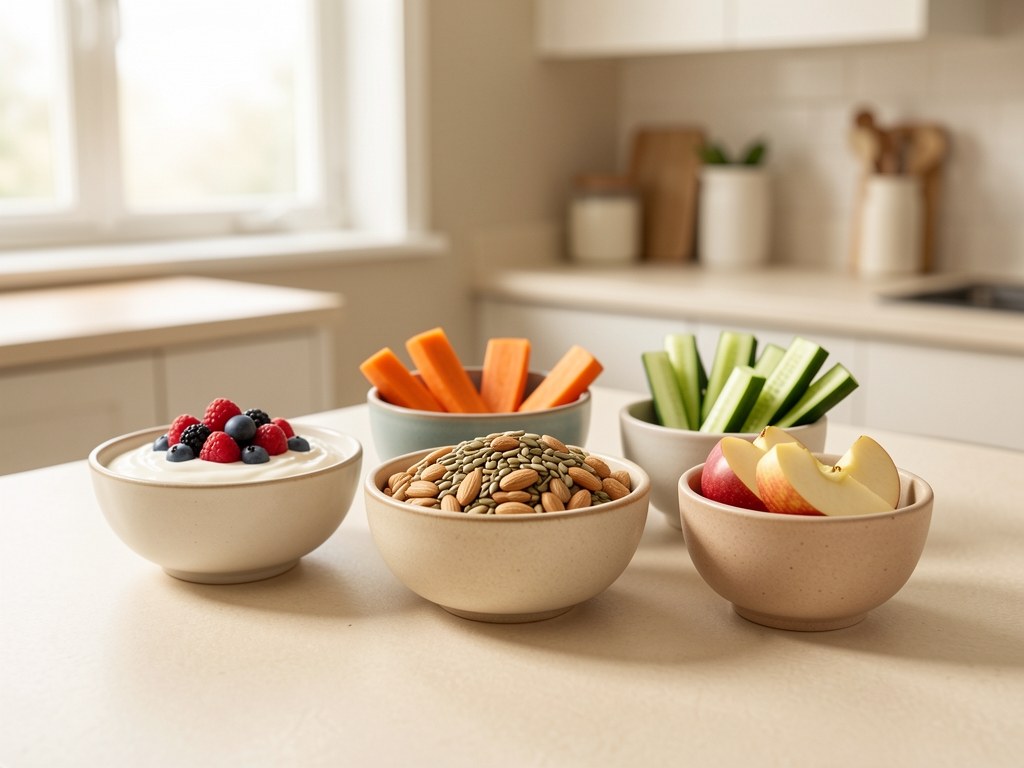
A balanced snack combines a source of protein or healthy fat with a source of fiber-rich carbohydrate. That pairing tends to be more satisfying than a snack made mostly of refined starch or sugar. Adding protein from nuts, beans, or low-fat dairy, or a whole grain, can give a snack more staying power so you do not get hungry again as quickly.
A useful rule of thumb from nutrition research is to keep mid-morning and mid-afternoon snacks modest: around 100 calories can help control appetite without turning a snack into a full meal. An adequate snack might be a piece of fruit, a cup of yogurt, or a spoonful of dried fruit. For a more substantial snack, pair a fruit or vegetable with a protein or fat source such as nut butter, cheese, or hummus.
- Start with a fruit, vegetable, or whole-grain base for fiber and carbohydrates.
- Add a protein or healthy fat: nuts, seeds, yogurt, cheese, beans, or nut butter.
- Keep portions modest so the snack complements meals rather than replaces them.
- Choose options with minimal added sugars, saturated fat, and sodium when possible.
Sources: MedlinePlus (NIH / U.S. National Library of Medicine), Nutrients (PMC), DietaryGuidelines.gov (USDA / HHS), Baker Heart and Diabetes Institute
Snack ideas for work
Snacks that travel well are often built from portable, shelf-stable ingredients. Registered dietitians suggest combinations such as apple slices with cheese, Greek yogurt with berries, and vegetables with hummus or guacamole. These pairings combine fiber with protein or fat, which helps them satisfy hunger longer than a snack made only of crackers or chips.
For vegetable-based snacks, a quarter cup of dip such as tzatziki, hummus, or salsa adds flavor and some protein or fat. A small handful of unsalted raw or dry-roasted nuts or seeds, about a quarter cup, is another portable option that is satisfying on its own. When you are choosing packaged snacks, look for options with more nutrients and fewer added sugars and sodium — the same principles that apply to snacks you assemble yourself.
- Apple slices with a small piece of cheese or a spoonful of nut butter.
- Greek yogurt with fresh or frozen berries.
- Carrot, cucumber, or bell pepper sticks with hummus, tzatziki, or salsa.
- A quarter cup of unsalted raw or dry-roasted nuts or seeds.
- A piece of whole fruit with a hard-boiled egg.
Sources: American Institute for Cancer Research (AICR), Baker Heart and Diabetes Institute, DietaryGuidelines.gov (USDA / HHS), Nutrients (PMC)
Snack Ideas for Home
At home you have more room to prepare snacks that take a few minutes but feel more like a small meal. A bowl of berries with plain yogurt, a sliced banana with a spoonful of peanut butter, or whole-grain toast with mashed avocado are simple options that combine carbohydrate, protein, and fat. These are meal ideas rather than strict recipes — adjust amounts to your hunger and preferences.
If you want to make homemade snack items, you can prepare muesli bars or protein balls in advance. The general approach is to combine rolled oats, nuts or seeds, a binder such as nut butter or mashed banana, and a small amount of dried fruit or honey, then shape and chill the mixture. Exact quantities and preparation steps are best taken from a tested recipe, since ingredient ratios affect texture and shelf life.
Frozen grapes, roasted chickpeas, and air-popped popcorn are other home-friendly options that can satisfy a craving for something crunchy without relying on salty snack foods.
- Berries with plain yogurt and a sprinkle of nuts.
- Whole-grain toast with avocado or nut butter.
- Roasted chickpeas with a pinch of paprika.
- Air-popped popcorn with a small amount of grated cheese.
- Homemade muesli bars or protein balls made with oats, nut butter, and dried fruit.
Sources: Baker Heart and Diabetes Institute, MedlinePlus (NIH / U.S. National Library of Medicine), American Institute for Cancer Research (AICR)
Snacks to limit
Not all snacks support a balanced diet. Unhealthy snacking patterns — especially high consumption of salty snacks, desserts, candy, and sweetened beverages — can lead to a diet that is energy-dense and nutrient-poor. Cakes, buns, biscuits, and sugary drinks contribute to increasing daily energy intake without providing much fiber, protein, or micronutrients. For children over age 4, more than 41 percent of daily snack calories have been found to come from foods such as chips, chocolate bars, soft drinks, fruit drinks, sugars, syrups, preserves, fats, and oils. That figure applies to children, not adults, but it illustrates how quickly snack choices can shift diet quality.
The Dietary Guidelines for Americans recommend limiting added sugars, saturated fat, and sodium. A healthy dietary pattern does not have much room for extra added sugars, saturated fat, or sodium, though a small amount can be added to nutrient-dense foods to help meet food group recommendations. In practice, this means choosing snacks that are closer to their whole-food form and reading labels on packaged snacks for added sugars and sodium.
- Limit snacks high in added sugars, such as candy, sweet baked goods, and sugary drinks.
- Watch sodium in chips, salted nuts, and many packaged snack mixes.
- Be cautious with snacks that are mostly refined starch or sugar; they are less likely to keep you satisfied.
- Use the Dietary Guidelines as a general frame: vegetables, fruits, whole grains, dairy, protein foods, and oils are the core of a healthy pattern.
Sources: PLoS ONE (PMC), Nutrients (PMC), DietaryGuidelines.gov (USDA / HHS)
Tips for Portioning Snacks
Portion size is one of the most practical levers you have for keeping snacks balanced. Putting a desired amount of food on a plate or in a bowl, rather than eating directly from a bag or box, helps you see how much you are eating and makes it easier to stop when you have had enough. This is a simple habit that can make a meaningful difference over time.
A modest snack of around 100 calories is often enough to take the edge off hunger between meals. For snacks that are more substantial, such as yogurt with fruit and nuts, a reasonable serving is one that leaves you comfortably satisfied but still ready to eat at your next meal. If you are unsure whether a snack is the right size, ask whether it is bridging the gap to your next meal or replacing it.
- Serve a portion onto a plate or bowl instead of eating from the package.
- Aim for a modest snack, around 100 calories, when you just need to bridge the gap to your next meal.
- Pair a carbohydrate with a protein or fat to improve satisfaction.
- Keep grab-and-go snacks in single-serving containers if you tend to overeat from larger packages.
Sources: MedlinePlus (NIH / U.S. National Library of Medicine), Nutrients (PMC)
Snack Preparation for a Busy Week
Preparing snacks in advance removes some of the friction that leads to less balanced choices when you are busy or hungry. A little planning can make it easier to reach for fruit, vegetables, yogurt, or nuts instead of whatever is closest at hand. The goal is not to spend hours in the kitchen but to make the healthy option the convenient option.
One approach is to wash and cut vegetables at the start of the week and store them in containers with a small amount of water so they stay crisp. Portion nuts, seeds, or dried fruit into small bags or containers. Keep yogurt, cottage cheese, or hard-boiled eggs where you can see them in the refrigerator. If you enjoy homemade bars or protein balls, make a batch and refrigerate or freeze individual portions. These steps turn a balanced snack into a default rather than a decision.
- Choose two or three snack combinations you actually enjoy and shop for those ingredients.
- Wash and cut vegetables and fruit, then store them in ready-to-eat containers.
- Portion nuts, seeds, and dried fruit into small containers or bags.
- Keep protein-rich options such as yogurt, cottage cheese, and hard-boiled eggs visible in the fridge.
- If making homemade bars or balls, prepare a batch and store individual portions in the fridge or freezer.
Sources: MedlinePlus (NIH / U.S. National Library of Medicine), Baker Heart and Diabetes Institute, American Institute for Cancer Research (AICR)
Frequently asked questions
What are the best snacks to have between meals?
The best between-meal snacks combine a source of fiber with protein or healthy fat. Examples include apple slices with cheese, berries with yogurt, vegetables with hummus, or a small handful of unsalted nuts. These combinations tend to be more satisfying than snacks made mostly of refined starch or sugar, so they help you get to your next meal without getting overly hungry.
Sources: MedlinePlus (NIH / U.S. National Library of Medicine), American Institute for Cancer Research (AICR), Baker Heart and Diabetes InstituteCan I snack before bedtime?
There is no single rule that applies to everyone. If you are hungry before bed, a modest snack that combines protein or fat with fiber — such as a small yogurt or a piece of fruit with a spoonful of nut butter — is a reasonable option for many people. If you have a health condition that affects eating timing, such as diabetes, ask a healthcare professional for guidance tailored to you.
Sources: Nutrients (PMC), MedlinePlus (NIH / U.S. National Library of Medicine)Are granola bars healthy?
Granola bars vary widely. Some are made mostly of oats, nuts, and dried fruit, while others contain substantial added sugars and refined ingredients. Rather than treating granola bars as automatically healthy or unhealthy, check the label for added sugars, saturated fat, and sodium, and consider how the bar fits into your overall eating pattern. A homemade bar or a simple combination such as fruit with nuts may be a more nutrient-dense choice.
Sources: DietaryGuidelines.gov (USDA / HHS), Baker Heart and Diabetes InstituteWhat are some protein-rich snack ideas?
Protein-rich snack options include Greek yogurt with berries, a hard-boiled egg with whole-grain crackers, cottage cheese with fruit, roasted chickpeas, edamame, and a small handful of nuts or seeds. Pairing protein with a fiber-rich carbohydrate, such as fruit or vegetables, tends to make the snack more satisfying.
Sources: MedlinePlus (NIH / U.S. National Library of Medicine), American Institute for Cancer Research (AICR), Baker Heart and Diabetes InstituteHow many calories should a snack have?
There is no universal number, but research on appetite control suggests that a modest snack of around 100 calories can be useful for mid-morning and mid-afternoon hunger. If your snack is functioning more like a small meal, it may naturally be larger. The more useful question is whether the snack is bridging the gap to your next meal or replacing it.
Sources: Nutrients (PMC)Is it better to snack on fruit or vegetables?
Both are good choices. Fruit-based snacks and vegetables are associated with better diet quality and a positive impact on body weight. Vegetables are lower in calories and sugar, while fruit provides natural sweetness and fiber. A practical approach is to include both across the week and pair them with a protein or fat source when you want the snack to be more filling.
Sources: Nutrients (PMC), Baker Heart and Diabetes InstituteWhat should I look for on a snack label?
Look at added sugars, saturated fat, and sodium, since the Dietary Guidelines for Americans recommend limiting these. Also check whether the snack provides meaningful fiber or protein rather than mostly refined starch. A snack that is nutrient-dense and moderate in added sugars, saturated fat, and sodium is generally a better fit for a balanced eating pattern.
Sources: DietaryGuidelines.gov (USDA / HHS), PLoS ONE (PMC)Sources
- 12 healthy snacks with 200 calories or less: MedlinePlus Medical Encyclopedia — MedlinePlus (NIH / U.S. National Library of Medicine)
- Snacking Consumption among Adults in the United States: A Scoping Review — Nutrients (PMC)
- Healthy Snack Project: Improving Healthy Choices through Multidisciplinary Food Education Actions — Nutrients (PMC)
- Dietary Guidelines for Americans, 2020-2025 - Executive Summary — DietaryGuidelines.gov (USDA / HHS)
- 30 Healthy Snack Ideas from Registered Dietitians — American Institute for Cancer Research (AICR)
- Healthy snacks — Baker Heart and Diabetes Institute
- Perception and demand for healthy snacks/beverages among US consumers vary by product, health benefit, and color — PLoS ONE (PMC)