Why Variety Is a Core Principle of Balanced Eating
Balanced eating is usually taught as proportions: more vegetables, fruits, whole grains, legumes and nuts, and fewer processed foods, meat and poultry, and sugar-sweetened beverages. Variety is the companion principle. Proportions tell you how much of your plate should come from each group; variety tells you how many different foods inside those groups you actually eat.
The two ideas work together because no single food supplies everything. A diet built on the same short list of foods can hit the right proportions on paper while still leaving gaps in specific vitamins, minerals, fiber types and beneficial plant compounds. Widening the list is a simple, low-cost way to close those gaps without counting every nutrient.
Variety also protects against boredom. When meals repeat too often, eating becomes routine rather than enjoyable, and enjoyment is part of what makes a pattern last.
- Proportions set how much of each food group you eat; variety sets how many different foods you eat within each group.
- A short rotation of otherwise healthy foods can still leave nutrient gaps over time.
- Repetition gets dull; variety makes a healthy pattern easier to maintain.
Sources: Nutrients (MDPI), hosted on PubMed Central (NIH/NLM), Frontiers in Public Health, hosted on PubMed Central (NIH/NLM)
How Variety Helps You Get Enough Nutrients
Different foods within the same group carry different nutrient profiles. Leafy greens, orange vegetables, tomatoes, mushrooms and legumes are all vegetables, but they are not interchangeable. Eating across the group increases the chance that you cover vitamins A, C and K, potassium, magnesium, folate and fiber without planning each one separately.
The same logic applies to grains, proteins and dairy or fortified alternatives. Whole grains, legumes, nuts and seeds each contribute different combinations of fiber, protein, B vitamins and minerals. Rotating them spreads your intake across those combinations.
This is the practical reason dietitians talk about food variety rather than a single perfect food. It is also why national guidelines are written as food-group targets: the groups are the framework, and the variety inside them does the nutrient work.
- Rotate within groups, not just between them: several vegetables, several grains, several protein sources.
- Include both raw and cooked forms where that fits your routine; preparation changes what is available and what you enjoy.
- Treat variety as a weekly habit rather than a daily checklist, so one repetitive day does not undo the pattern.
Sources: Nutrients (MDPI), hosted on PubMed Central (NIH/NLM), Frontiers in Public Health, hosted on PubMed Central (NIH/NLM)
The Health Benefits of Eating a Range of Colors
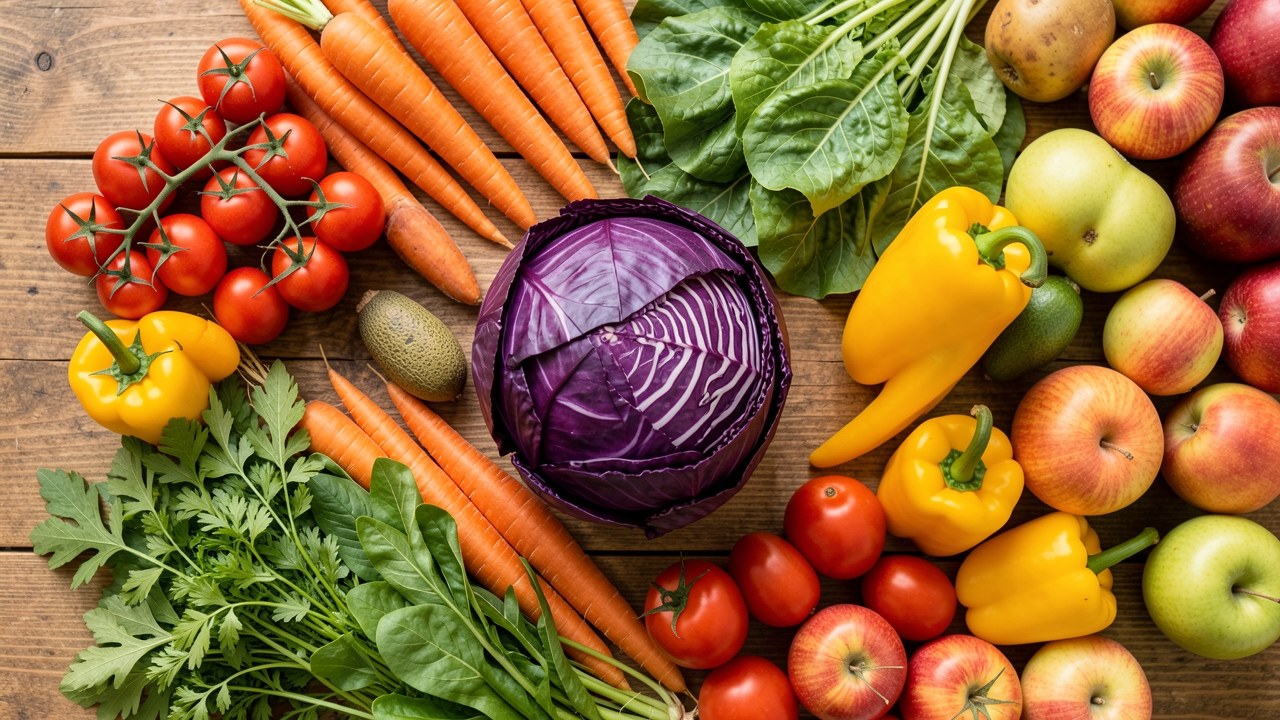
Color is a rough visual cue for different plant compounds. Deep orange and red produce tends to be rich in carotenoids; dark green leaves bring folate, vitamin K and minerals; purple and blue foods carry anthocyanins; and white and tan plant foods such as onions, garlic, cauliflower and mushrooms contribute their own compounds. Eating a rainbow is shorthand for covering those families, and it is one of the simplest ways to diversify your diet without tracking nutrients.
Population data make the case for improving intake. According to a national survey cited in a peer-reviewed policy analysis, roughly 90% of Americans do not eat the recommended amounts of fruits and vegetables. Adding color is one of the most direct ways to move that number in the right direction.
There is also evidence that a varied, food-based pattern has measurable health value. A peer-reviewed review of national guidelines describes the DASH dietary pattern as a food-based plan that specifies amounts to eat per day or week, similar in structure to other national food-based guidelines. The same review summarizes a 2020 meta-analysis of 30 randomized controlled trials that found a significantly positive effect of the DASH diet on blood pressure.
Finally, variety is not limited to produce. A qualitative study following a Dietary Guidelines-based intervention recorded a participant describing enjoyment and pride in eating a range of foods they would not normally eat. That is a single person's account, not a general finding, but it illustrates how expanding variety can feel rewarding rather than restrictive.
- Aim across color families: dark green, orange and red, purple and blue, and white or tan.
- About 90% of Americans fall short on fruits and vegetables, so adding color is a high-value change.
- The DASH pattern shows that a food-based, varied eating plan can support health outcomes such as blood pressure.
- Variety is not only about plants; rotating protein sources and grains counts too.
Sources: Nutrients (MDPI), hosted on PubMed Central (NIH/NLM), Frontiers in Public Health, hosted on PubMed Central (NIH/NLM)
Barriers to Dietary Variety and How to Overcome Them
Taste and cost are the barriers that come up most often. A peer-reviewed U.S. census-representative survey of 1,182 adults, plus a low-income sample of 506 adults, found that taste and cost were key barriers to healthy eating across the survey questions, and that nutritional value was not a priority among respondents. That finding is important for variety: people do not adopt new foods because they are told the foods are nutritious. They adopt them because the food tastes good and fits the budget.
The same survey identified practical facilitators: access to budget-friendly, good-tasting recipes, and preparing a grocery list in advance. The authors recommend that programs aiming to improve diet quality emphasize flavor and taste as part of healthy eating.
Access is a separate barrier. A peer-reviewed review of nutritional barriers found that lack of nutrition knowledge, limited food access and food cost are major obstacles to sticking with a healthy pattern, and noted that low-adherence communities in the U.S. are often located in food deserts and food swamps. Perceived cost appears repeatedly: in the populations reviewed in that literature, only 2.6% of respondents described the studied dietary pattern as affordable, a figure that applies to those reviewed groups rather than to the U.S. population as a whole.
Rural households face their own mix. A focus-group study across seven U.S. rural states, with women whose communities averaged under 5,000 residents, identified barriers including the perception that healthy foods are too expensive, large portion sizes at family meals, and frequent eating away from home that was perceived as unhealthy. The same study found facilitators in local farmers' markets and community supported agriculture farm shares, and in local food culture such as hunting, gardening, canning and smoking.
Children report barriers too, and they are not always the ones adults assume. A study of 274 students in grades 5 and 6 found that children most often named barriers tied to their own intake and to peers' food choices, and less often named family-related barriers such as the food available at home. The authors suggest interventions built on hands-on meal planning, such as making a colorful and varied meal with playdough and then checking the result against a goal the child set. Because that study was conducted with Portuguese schoolchildren, treat the specifics as illustrative rather than directly transferable.
- Lead with taste and budget, not with nutrient claims; those are the levers the U.S. survey identified.
- Keep a running grocery list and collect a few budget-friendly recipes you actually like.
- Use farmers' markets, farm shares and seasonal local produce where they are available.
- Shrink the change: one new food per week is easier to accept than a whole new menu.
- Involve children in choosing and preparing a colorful meal rather than presenting it as a rule.
Sources: Public Health Nutrition (Cambridge University Press), hosted on PubMed Central (NIH/NLM), Frontiers in Public Health, hosted on PubMed Central (NIH/NLM), Foods (MDPI), hosted on PubMed Central (NIH/NLM), Journal of Nutrition and Metabolism (Wiley/Hindawi), hosted on PubMed Central (NIH/NLM), International Journal of Environmental Research and Public Health (MDPI), hosted on PubMed Central (NIH/NLM)
Simple Swaps to Increase Variety in Each Food Group
The easiest way to diversify a diet is to keep the meal and change one component. These swaps preserve familiar flavors while widening the range of foods you eat.
For vegetables, swap one habitual vegetable for one from a different color family, or mix two preparations of the same vegetable, such as raw and roasted. For fruits, rotate the fruit you eat at breakfast instead of repeating the same one all week. For grains, alternate among whole grains such as oats, brown rice, barley, quinoa and whole-grain bread or pasta. For proteins, rotate among beans and lentils, eggs, fish, poultry, tofu and yogurt. For dairy or fortified alternatives, alternate between options rather than settling on one.
- Vegetables: replace one default with a different color family, or serve one raw and one cooked.
- Fruits: choose a different fruit each morning rather than the same one every day.
- Grains: rotate oats, brown rice, barley, quinoa and whole-grain bread or pasta across the week.
- Proteins: alternate beans and lentils, eggs, fish, poultry, tofu and yogurt.
- Dairy and fortified alternatives: build in two or three options instead of one.
- Snacks: keep two or three varieties on hand so the default is not always the same item.
- Choose one food group to start with, not all of them at once.
- Pick two or three foods in that group you already like and one you are curious about.
- Add the new food alongside a familiar one in a dish you already cook.
- Repeat it once more within two weeks so it becomes familiar rather than novel.
- Move to the next food group once the first swap feels routine.
Sources: Nutrients (MDPI), hosted on PubMed Central (NIH/NLM), Public Health Nutrition (Cambridge University Press), hosted on PubMed Central (NIH/NLM), Frontiers in Public Health, hosted on PubMed Central (NIH/NLM)
A Weekly Variety Challenge to Expand Your Palate
A weekly challenge turns variety from an intention into a habit. The goal is not to hit a specific number of foods, because there is no single agreed target for how many different foods a person should eat each week. The goal is to steadily widen your range across food groups and to notice what you enjoy.
A useful structure is to set one small target per week: one new vegetable, one new whole grain, one new protein source, or one new way of preparing a food you already eat. Write it down where you plan meals. At the end of the week, note whether you would eat it again. Keeping the ones you liked is what turns a challenge into a lasting pattern.
If cost or access limits what you can try, work with what is local and in season, and lean on budget-friendly recipes and a written grocery list, the two facilitators identified in the U.S. survey. Farmers' markets and community farm shares, where available, are another route to unfamiliar foods.
- Week 1: one new vegetable, prepared a way you already like.
- Week 2: one new whole grain in place of your usual grain.
- Week 3: one new protein source, such as lentils or a different fish.
- Week 4: one new fruit and one new herb or spice.
- Keep a short note of what you would eat again; drop the rest without guilt.
Sources: Public Health Nutrition (Cambridge University Press), hosted on PubMed Central (NIH/NLM), Frontiers in Public Health, hosted on PubMed Central (NIH/NLM), Journal of Nutrition and Metabolism (Wiley/Hindawi), hosted on PubMed Central (NIH/NLM)
A Sample Day of Balanced Meals with Built-In Variety
The day below is an illustration of how variety can be built into ordinary meals. It is not a prescribed plan, and portions should follow your own needs. The point is the structure: several food groups at each meal, and different foods inside each group across the day.
Breakfast combines a whole grain, a fruit and a protein or dairy option. Lunch combines a vegetable, a whole grain and a protein source, with a second vegetable or a fruit on the side. Dinner rotates the grain, the protein and at least two vegetables from what you ate earlier. Snacks use whatever group was thinnest that day.
Across the week, the rotation is what matters. If Monday used oats, rice and beans, Tuesday can use whole-grain bread, barley and eggs, and Wednesday can use quinoa, fish and lentils. The meal shapes stay familiar while the foods inside them change.
- Breakfast: whole-grain option, a fruit, and a protein or dairy food.
- Lunch: a vegetable, a whole grain and a protein source, plus a second vegetable or a fruit.
- Dinner: a different grain, a different protein and at least two vegetables.
- Snacks: fill in the food group that was lightest that day.
- Across the week: change the specific grain, protein and vegetables rather than the meal pattern.
Sources: Nutrients (MDPI), hosted on PubMed Central (NIH/NLM), Public Health Nutrition (Cambridge University Press), hosted on PubMed Central (NIH/NLM), Frontiers in Public Health, hosted on PubMed Central (NIH/NLM)
How Variety Fits the Current Dietary Guidance
The Dietary Guidelines for Americans form the basis of federal nutrition programs and policies and are updated every five years, informed by current nutrition research. The peer-reviewed policy analysis in this guide describes the 2020–2025 edition, which emphasized greater intakes of whole grains, vegetables, fruits, legumes and nuts, and lower intakes of processed foods, meat and poultry, and sugar-sweetened beverages. That same edition advised limiting added sugars to less than 10% of daily caloric intake. As of 2026, the most recent edition is the 2025–2030 Dietary Guidelines for Americans; the 2020–2025 edition discussed here is not the current federal guidance. Readers who want the latest version should consult the current Dietary Guidelines for Americans.
Guidance from other countries is useful for comparison but is not U.S. policy. Brazil's national dietary guideline includes explicit recommendations designed to help people overcome obstacles to healthy diets, addressing people both personally and as citizens who can act locally, municipally and nationally. Its golden rule is to always prefer natural or minimally processed foods and freshly made dishes and meals over ultra-processed products, and it also recommends eating at regular and adequate meal times, in appropriate eating environments, and in the company of family, friends or colleagues. This is Brazil's guideline, not U.S. policy.
The U.S. guidelines can also be tailored to a wide variety of cultural preferences and ethnic traditions, which matters for variety: the familiar foods of your own cooking tradition are a legitimate starting point for broadening your range.
- The 2020–2025 Dietary Guidelines for Americans emphasized more whole grains, vegetables, fruits, legumes and nuts and fewer processed foods and sugar-sweetened beverages.
- That edition advised limiting added sugars to less than 10% of daily calories.
- The guidelines are updated every five years; as of 2026, check the 2025–2030 edition for the latest advice.
- Brazil's guideline is an example of a national guideline that explicitly addresses overcoming obstacles to healthy eating, but it is not U.S. policy.
- Cultural and ethnic food traditions are compatible with the U.S. guidelines and are a natural route into greater variety.
Sources: Public Health Nutrition (Cambridge University Press), hosted on PubMed Central (NIH/NLM), Frontiers in Public Health, hosted on PubMed Central (NIH/NLM), Nutrients (MDPI), hosted on PubMed Central (NIH/NLM)
Frequently asked questions
How many different foods should I aim to eat each week?
There is no single agreed numeric target for how many different foods a person should eat each week. A more useful aim is coverage across food groups and across color families within those groups, and a steady rotation of grains, proteins and vegetables rather than the same few items. Track variety qualitatively: if most of your meals use the same grain, the same protein and the same two vegetables, that is where to add something new.
Sources: Nutrients (MDPI), hosted on PubMed Central (NIH/NLM), Public Health Nutrition (Cambridge University Press), hosted on PubMed Central (NIH/NLM)Is it better to buy fresh or frozen for variety?
Both can support a varied diet. Fresh produce is often at its best in season and is a natural way to try unfamiliar foods, while frozen and canned options extend what is available year-round and can be budget-friendly. If cost is a limiting factor, frozen and canned forms are a practical way to keep more different vegetables and fruits on hand rather than fewer.
Sources: Frontiers in Public Health, hosted on PubMed Central (NIH/NLM), Foods (MDPI), hosted on PubMed Central (NIH/NLM)What are unusual nutrient-dense foods worth trying?
Rather than chase exotic items, look for foods that are unfamiliar to you but belong to groups you already eat: a different whole grain such as barley or quinoa, a different legume or lentil, a less common vegetable from another color family, or a new fish. Local farmers' markets and community supported agriculture shares are a reliable way to encounter foods you would not otherwise try, and they also tend to be fresher.
Sources: Frontiers in Public Health, hosted on PubMed Central (NIH/NLM), Journal of Nutrition and Metabolism (Wiley/Hindawi), hosted on PubMed Central (NIH/NLM)How can I encourage my family to accept more variety?
Start with taste rather than nutrition messaging, since a U.S. survey found taste and cost to be the main barriers to healthy eating and nutritional value was not a priority for respondents. The same survey pointed to budget-friendly, good-tasting recipes and advance grocery lists as facilitators. Add one new food alongside a familiar one, involve family members in choosing and preparing it, and keep the dishes you all liked. For children, a study of fifth and sixth graders suggests hands-on activities, such as planning a colorful meal and checking it against a goal the child sets, can help them engage with variety.
Sources: Frontiers in Public Health, hosted on PubMed Central (NIH/NLM), International Journal of Environmental Research and Public Health (MDPI), hosted on PubMed Central (NIH/NLM)Do I need to give up my usual meals to add variety?
No. Variety works best as an addition, not a replacement. Keep the meals you already cook and change one component at a time, such as swapping the grain or adding a second vegetable from a different color family. Over a few weeks those small changes widen your range considerably while keeping the food familiar and enjoyable, which is what makes the change last.
Sources: Public Health Nutrition (Cambridge University Press), hosted on PubMed Central (NIH/NLM), Frontiers in Public Health, hosted on PubMed Central (NIH/NLM)What gets in the way of eating a wider range of foods?
Taste and cost are the most consistently reported barriers in U.S. survey data, and lack of nutrition knowledge, limited food access and food cost are major obstacles to sticking with a healthy eating pattern. Low-adherence communities in the U.S. are often located in food deserts and food swamps. Rural households also report the perception that healthy foods are expensive, large portion sizes at family meals, and frequent meals away from home. The practical counterweights are budget-friendly recipes you genuinely like, a written grocery list, and local sources such as farmers' markets and farm shares where they exist.
Sources: Frontiers in Public Health, hosted on PubMed Central (NIH/NLM), Foods (MDPI), hosted on PubMed Central (NIH/NLM), Journal of Nutrition and Metabolism (Wiley/Hindawi), hosted on PubMed Central (NIH/NLM)Is this page personalized nutrition advice?
No. The information here is general nutrition education about dietary variety within a balanced eating pattern. If you have a medical condition, a food allergy, or specific dietary requirements, work with a qualified health professional who can tailor general guidance to your situation.
Sources: Frontiers in Public Health, hosted on PubMed Central (NIH/NLM), Nutrients (MDPI), hosted on PubMed Central (NIH/NLM)Sources
- Typical Guidelines for Well-Balanced Diet and Science Communication in Japan and Worldwide - PMC — Nutrients (MDPI), hosted on PubMed Central (NIH/NLM)
- Dietary guidelines to nourish humanity and the planet in the twenty-first century. A blueprint from Brazil — Public Health Nutrition (Cambridge University Press), hosted on PubMed Central (NIH/NLM)
- U.S. food policy to address diet-related chronic disease — Frontiers in Public Health, hosted on PubMed Central (NIH/NLM)
- Household barriers and facilitators to healthy eating in a U.S. census-representative sample of the general population and a low-income sample: a cross-sectional survey - PMC — Frontiers in Public Health, hosted on PubMed Central (NIH/NLM)
- Nutritional Barriers to the Adherence to the Mediterranean Diet in Non-Mediterranean Populations — Foods (MDPI), hosted on PubMed Central (NIH/NLM)
- Understanding Barriers and Facilitators to Healthy Eating and Active Living in Rural Communities — Journal of Nutrition and Metabolism (Wiley/Hindawi), hosted on PubMed Central (NIH/NLM)
- Children’s Perceived Barriers to a Healthy Diet: The Influence of Child and Community-Related Factors — International Journal of Environmental Research and Public Health (MDPI), hosted on PubMed Central (NIH/NLM)
- Perceptions of the Three Dietary Patterns of the 2020–2025 United States Dietary Guidelines Among African American Adults After a 12-Week Randomized Intervention Trial to Reduce Type 2 Diabetes Risk: A Qualitative Study — Nutrients (MDPI), hosted on PubMed Central (NIH/NLM)